Digital nomads are defined as people who choose to embrace a location-independent, technology-enabled
MBO partners
lifestyle that allows them to travel and work remotely, anywhere in the Internet-connected world. Unlike regular
remote workers, who tend to stay in one geographic area, digital nomads travel and explore while working.
Digital nomads work in a wide variety of fields, including information technology (12 percent), education and
training (11 percent), consulting, coaching, and research (11 percent), sales, marketing, and PR (9 percent), and
creative services (8 percent) with other fields represented relatively equally. The unifying theme of these
professions is that they can be performed remotely using digital tools and the Internet.
Digital nomads work in a wide variety of fields, including information technology (12 percent), education and
training (11 percent), consulting, coaching, and research (11 percent), sales, marketing, and PR (9 percent), and
creative services (8 percent) with other fields represented relatively equally. The unifying theme of these
professions is that they can be performed remotely using digital tools and the Internet.
To help stretch their income, many if not most digital nomads work from places with relatively low costs of living.
At the same time, they often virtually serve customers in higher-wage labor markets. Combining low-cost living
with earning income at the wage rates of higher-cost locations, they’re able to take advantage of what’s known as geoarbitrage.
Popularized by Tim Ferriss’ best-selling book The 4-Hour Workweek, geoarbitrage enables digital nomads to fund their travels and spend less time working to support themselves and more time enjoying their adventures.
In prior years, this has meant working from low-cost countries like Thailand, Costa Rica, or Vietnam while serving
customers in the U.S.
This year, however, due to COVID-related travel restrictions, this has meant traveling from
higher-cost cities like New York and San Francisco to lower-cost areas in U.S. Cities like Boulder, CO, and Austin, TX
as well as resort areas like Boca Raton, FL and Bozeman, MT.
Still, digital nomadism aside, Lund says that based on McKinsey research, “60-70% of the workforce has zero opportunity” to work remotely at all. Most people are “cutting hair, they’re caring for patients, they’re in a manufacturing setting where you’re working machinery or in a laboratory working with specialised equipment”.
«Definitely, there is an issue of equity,» says Lund. «It is college-educated, office-based, white-collar workers predominately that can do this.»
Overall, says Kelly, “I would say 100% remote work is a possibility for some employees, and maybe feasible in some industries, but it’s not going to become the new normal.”
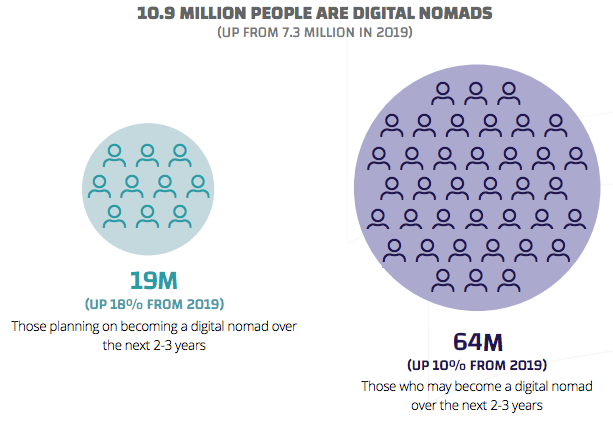
Despite their aspirations, most of these people will
not become digital nomads. Instead, they will
continue to be what we call “armchair digital
nomads,” those who follow the exploits of others
instead of becoming digital nomads themselves.
However, this data shows how extensive the
interest is in this lifestyle. It also shows how the shift
to remote work, especially for traditional jobholders, is making the idea of becoming a digital nomad more popular.
THE FUTURE OF NOMADISM
The pandemic-induced shift to remote work has taught businesses of all sizes that remote work works. This has
led to broad support from executives, managers, and workers to continue allowing both flexible work schedules
and remote working arrangements after the pandemic ends.3
This shift is impacting the digital nomad trend in
three major ways.
More traditional employees will become digital nomads:
Corporations have been hesitant to allow their employees to become nomadic. This has changed and
a large and growing number of companies have announced plans to allow a much greater degree, of
remote work long term. This gives millions of people the ability to become more nomadic—and as this
year’s data shows, many have already become digital nomads. Many more will join them in the coming
years.
Closer to home travel:
While the end of the pandemic will see the return of digital nomads flying from country to country, a
significant number will instead choose to stay closer to home. Many companies will likely adopt hybrid
work models, and even nomadic workers will be expected to show up at the office on at least an
occasional basis.
Nomads will also choose relative proximity due to a need to be in a similar time zone
as coworkers. These two location criteria open the door for more VanLifers and RV-based nomads.
Longer stays, less travel:
At least as long as the pandemic lasts, digital nomads will likely choose to stay put more and travel less.
We expect this trend to continue even after the pandemic ends. This is due to nomads learning the
advantages of exploring a place and culture in-depth. Adding to this is the less frenetic lifestyle
associated with longer stays. Digital nomads also report they’re more productive workwise when they
travel less. Airbnb is already reporting stays of 28 days or longer is one of their fastest growing rental
segments and it expects this trend to continue to accelerate.5
References
https://www.bbc.com/worklife/article/20210615-is-the-great-digital-nomad-workforce-actually-coming
https://s29814.pcdn.co/wp-content/uploads/2020/10/MBO-Digital-Nomad-Report-2020-Revised.pdf
https://en.wikipedia.org/wiki/Digital_nomad
Infographics